Is Jane Magnolia Native to the United States?
In 1955, at the US National Arboretum in Washington, DC, a geneticist crossed two Asian magnolias and started a line of seedlings that would include Jane. A plant with a birth year and a birthplace raises a fair question. Can it have a native range at all?
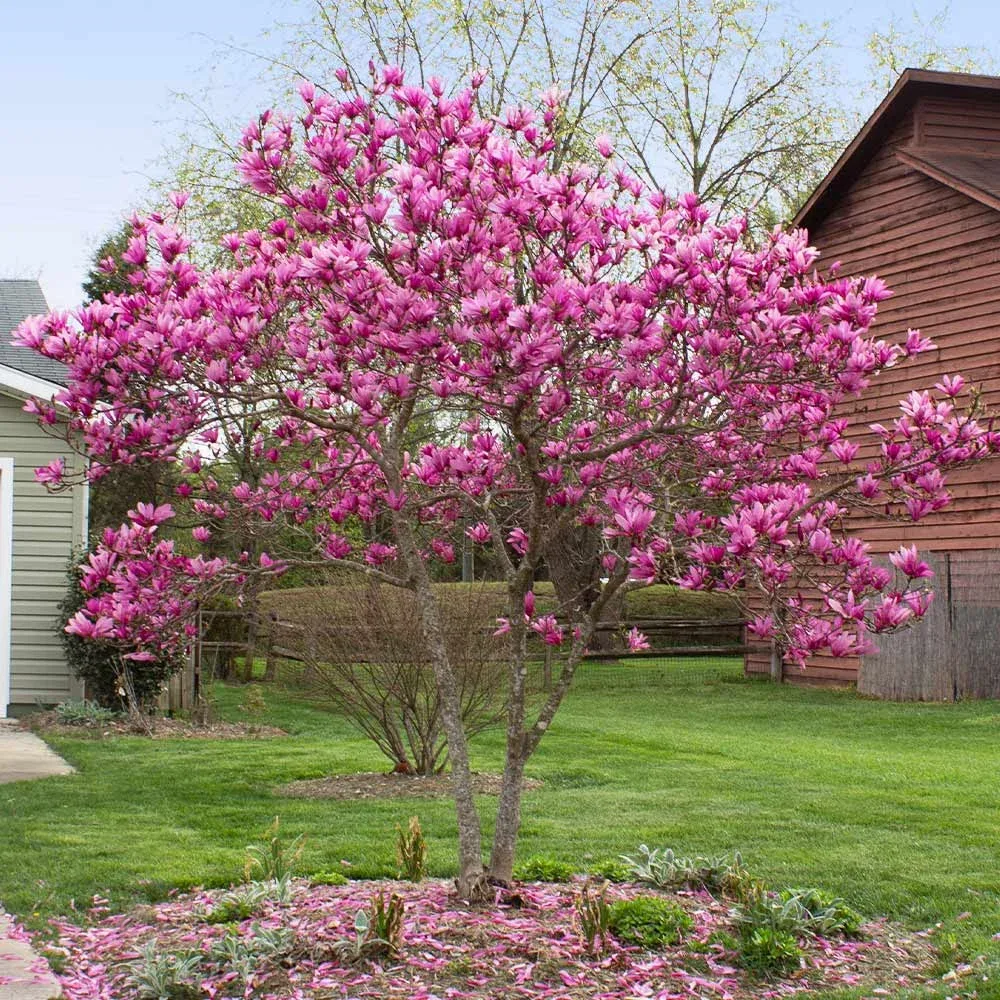
It cannot, and it is one of the questions customers ask us most, often as "is Jane magnolia native to Virginia?" Jane grows wild nowhere, in any state or country. It is a bred garden tree, and the useful facts about it are its zones, its size and its bloom date, not its habitat.
Below, you'll find out all about where Jane came from, including the 1950s breeding work, the eight-plant Little Girl series, how native plant lists treat hybrids, and the zone, size and bloom numbers to check before you plant.
One Hybrid, Zero Wild Populations
Jane Magnolia is not native to the United States, to Virginia or to any other place. A native plant arose in a region through natural processes and grew there before people moved it around. Jane did not arise that way. Breeders made controlled crosses, raised the seedlings and picked one. That leaves no wild population, no natural habitat and no range map to point to.
Being born in the United States does not make a plant native here. Jane was bred in Washington, DC, from parents that grow wild in Asia. The accurate label is American-bred. Virginia gardeners ask often because Washington is close by, but the answer is the same in every state.
You may have searched "Jane magnolia native range" or "where is Jane magnolia native." Both ask for a place, and there isn't one. The only places tied to Jane are the arboretum where it was selected and the Asian regions where its parents grow.
Not being native does not make Jane a poor choice. Native status tells you where a species grew before gardens existed. It does not tell you whether a tree will survive your winters or fit your yard. For that you need zone, height and site numbers, and we give those further down.
How Jane Magnolia Began at the National Arboretum
The Little Girl series began as a two-person breeding effort. The Arkansas extension service records that the original crosses were made in 1955 by US National Arboretum geneticist Dr. Francis de Vos, and in 1956 by horticulturist William Kosar. Two people, two years, one arboretum. Every Little Girl hybrid traces back to that work.
Jane's own line is documented down to the parent cultivars. Jane was selected from the progeny of M. liliiflora 'Reflorescens' crossed with M. stellata 'Waterlily'. Selected from the progeny is the key phrase. Breeders crossed the parents, raised the seedlings and chose this one.
The Arkansas page describes Jane as a cross between the same two parents, which fits that account. The cross produced the seedlings, and Jane is the seedling that was kept and named.
The Two Parent Magnolias
Both parents are Asian species, and the cross paid off in timing. The Little Girl series flowers from mid-April to early May, about two to four weeks later than its parent species. That shift is the clearest trait the breeding added. A later bloom opens after more of the early-spring cold has passed, though your own last frost date still sets the risk.
Magnolia liliiflora supplies the 'Reflorescens' side of the cross, and Magnolia stellata, the star magnolia, supplies 'Waterlily'. Each has its own native geography, which we cover in the native range section below.
Where the Records Disagree
The Arkansas page lists the cross as 'Reflorescens' by 'Waterlily'. Other sources give different parentage for Jane. We follow the university record, because it names specific parent cultivars. If a catalog shows a different pair, treat it as unverified.
Eight Little Girl Crosses and Their Numbers
Jane is one of eight hybrids that the Arkansas extension service calls "the Girls." The series was built on purpose, as a planned program and not a chance seedling. The table below gathers the figures our university sources support, so you can see how small and how specific the origin is.
| Item | Figure |
|---|---|
| Original crosses by Dr. Francis de Vos | 1955 |
| Original crosses by William Kosar | 1956 |
| Hybrids in the series | 8 |
| Place of the work | US National Arboretum |
| Jane's parents | M. liliiflora 'Reflorescens' x M. stellata 'Waterlily' |
| Series bloom window | Mid-April to early May |
Read the table for what it leaves out. We list no seedling counts, no selection year for each of the eight and no names beyond Jane, because none of our sources give them. Anything more exact than 1955 and 1956 for the original crosses would be a guess.
Two details matter for the native question. The work happened in one place, a government arboretum, inside a two-year window. A species spreads across a wide region over a long span of time. A cultivar has an address and a date.
Eight hybrids from one program share a breeding history, not a habitat. None of the eight has a wild population, so the answer for Jane applies to its siblings too. If you want to see how Jane differs from the other seven, we compare them in Jane Magnolia and the Little Girl hybrids compared.
Why Jane Magnolia Has No Native Range
A native range describes where a species grows without help from people. A cultivar has no such range, because it is a single named selection and not a wild population. Jane exists because breeders picked one plant from one set of seedlings in the 1950s. Every Jane in a garden traces back to that choice. Its parents are the ones with geography.
Where the Parents Come From
Both parent species are Asian, and the sources agree on where. These are the points that settle it.
- Magnolia liliiflora is native to South-Central and Southeastern China, where it grows on slopes and forest edges in the wild.
- Magnolia stellata is native to Japan.
- Jane itself has a Washington, DC, birthplace and no wild source population anywhere in the United States or Asia.
What the Parents Cannot Tell You
A hybrid does not inherit a range by adding up its parents. Jane's rating for zones 4a to 8b is a garden rating, not a habitat. Its size and bloom date describe the planted tree, not a wild stand. Asking where a cultivar is native gets you the origin of its parents, not of the plant in your yard.
The same caution applies to site needs. A species that grows on forest edges in China does not tell you where Jane belongs in your yard. Jane suits full sun and partial shade, and we use those ratings, not the parent's wild habitat.
Where Jane Magnolia Fits on Native Plant Lists
Native plant programs build their lists around species with a documented wild range in a region. A bred hybrid has no such range, so it does not qualify on a strict reading. Rules differ from program to program, so read the one you follow. For Jane the question is settled anyway, since both parents come from Asia.
Common advice says to plant only natives. We agree that natives should anchor a wildlife-minded garden. We would not stretch the word to cover a hybrid, and retail copy that makes any American-bred plant sound native does the buyer no favors. Label Jane honestly in your plan and it will serve its place fine.
Using Jane in a Wildlife-Minded Garden
Wildlife gardeners ask whether a non-native magnolia still earns a place. We have no verified study of what visits Jane, so we will not name a visitor. What we can say is that it blooms from mid-April to early May, later than its parent species. That matters if you plan flowers across the season. For local wildlife value, ask your state extension service.
Customers who raise native status are usually building a mixed border and want to know where one magnolia can sit among natives. Our answer is to let natives set the structure and use Jane where its size, 10 to 15 feet tall, suits the bed. For Virginia, your state's native plant society can tell you how it treats cultivars.
Planting Jane Magnolia in Zones 4 to 8
The history gives you a useful set of numbers. Jane is hardy in USDA zones 4a through 8b, a wide spread of winter lows. Check your own zone and ask your local extension service about spring frost dates. Our guide to the best growing zones for Jane Magnolia goes through the range in more detail.
The table below puts the planting facts from our sources in one place. All of them describe the cultivar, not a wild plant.
| Item | Figure |
|---|---|
| USDA zones | 4a to 8b |
| Mature height | 10 to 15 feet |
| Mature width | 8 to 12 feet |
| Bloom window | Mid-April to early May |
| Sun | Full sun (6 or more hours) to partial shade (2 to 6 hours) |
| Soil pH | Acid (below 6.0) and neutral (6.0 to 8.0) |
Size and Bloom Date
Jane is slow-growing. Its mature size is 10 to 15 feet tall and 8 to 12 feet wide, with a cap of 15 feet by 12 feet. It is late blooming, mid-April to early May. Read how big Jane gets before you pick a spot, and see our bloom time guide for what to expect each spring.
We often see Jane planted too close to a walk or a wall, because a young plant looks small. Give it the full 8 to 12 feet of width.
Sun, Soil and Pruning
Jane grows in full sun, meaning 6 or more hours of direct light a day, and in partial shade, meaning 2 to 6 hours. It accepts acid soil (below pH 6.0) and neutral soil (6.0 to 8.0), and it tolerates heavy clay, air pollution and heat. Our soil guide for Jane Magnolia covers drainage and amendments.
Prune sparingly, only to remove dead or broken branches. If you need to maintain shape, do it after flowering.
Jane Magnolia as a Garden Plant, Not a Wildflower
Jane is a bred ornamental with a documented origin. It came from a 1950s cross at the US National Arboretum, as one of eight Little Girl hybrids, from two Asian parent species. It has no native range, no wild population and no place on a strict native plant list. Choose it for what it gives a garden: slow growth to 10 to 15 feet, a late bloom from mid-April to early May and a rating for zones 4 to 8.
American-bred, not American-native, and good in zones 4 to 8.
Jane Magnolia
Nursery-grown Jane Magnolia in sizes from 1 Gallon 1-2 Feet Multi Stem, shipped to your door.
From $80.55
Shop Now →Jane is a late bloomer, so we give it the brightest spot we have: open rows on our own farms with six or more hours of direct sun. Our own growers raise and pack every top-quality tree and shrub we send out. If you have decided that a bred American magnolia belongs in your garden, choose your Jane in our shop.